
Club News
June Lunch: Chairman, Andrew Carver, welcomed 19 members and our guest speaker Richard Freeman, a member of Sanderstead & Riddlesdown Probus, and his wife, Christine. £38 was raised for the Chairman’s Charity, Old Coulsdon Centre for Retired. The raffle raised £32.
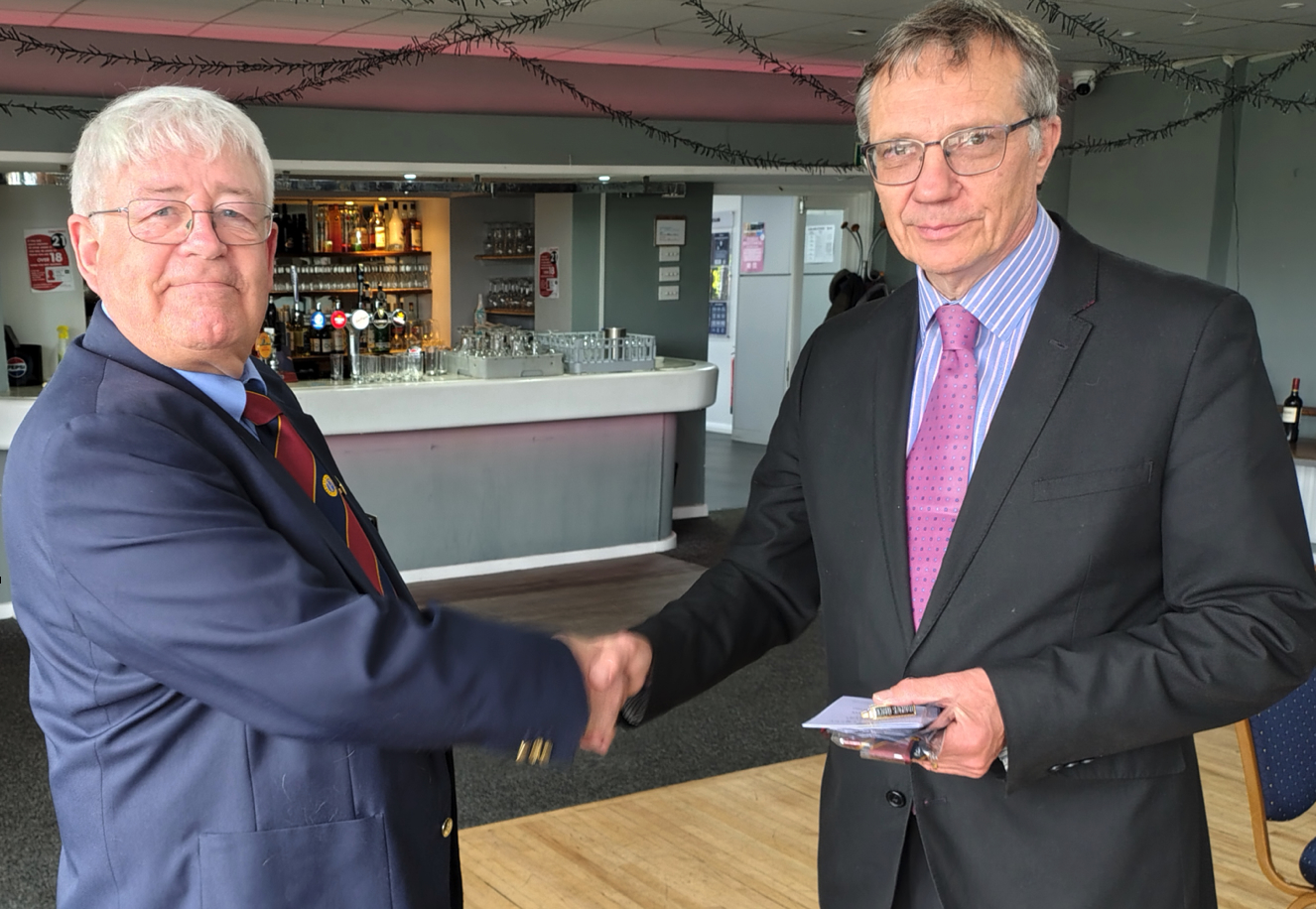
New Member Induction: Chairman Andrew Carver presents Richard Seagroatt with Badge, Tie and Handbook.
News of Members: Ian Payne is recovering well and intends to make the July meeting.
The Chairman announced the sad news of the death of John Morgan, who died whilst visiting his brother in Dorset. His funeral was held on 22nd June.
Birthdays in July: John Crumplin, Chris Moniz, Paul Sandford.
Outings/Events: A visit to Hampton Court has been arranged for 16 July, to include a private costume guided tour. A guided tour of The Skinners’ Livery Hall is planned for later this year. Contact Terry on tribbs42@gmail.com for further suggestions.
Speaker today: Roger Tristram – ‘Motor Sport and Milk’ (history of the Indy 500 motor race). [contact08450573286] 6th August 2026: ‘Lasting Power of Attorney Made Simple’.
Welfare Officer: Please contact Tony Farrell if anyone knows of a member in difficulty: tonyfarrell1953@gmail.com
Lunch changes by 10.30am prior Tuesday: chris@moniz.co.uk T: 020 8660 6063.
Newsletter articles please to vincent@fosdike.com
June Guest Speaker: Richard Freeman ‘Guide Dogs for the Blind’
by Bill Baldock
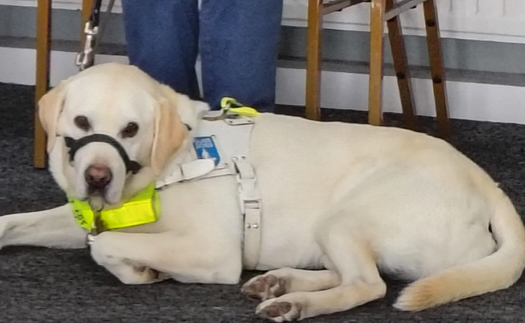
In June we welcomed Richard Freeman and his dog Twiggy to talk about Guide Dogs. Richard is a member of Sanderstead and Riddlesdown Probus and some of us will remember him from the Quiz Night and Skittles evenings. We were pleased also to welcome Richard’s wife, Christine.
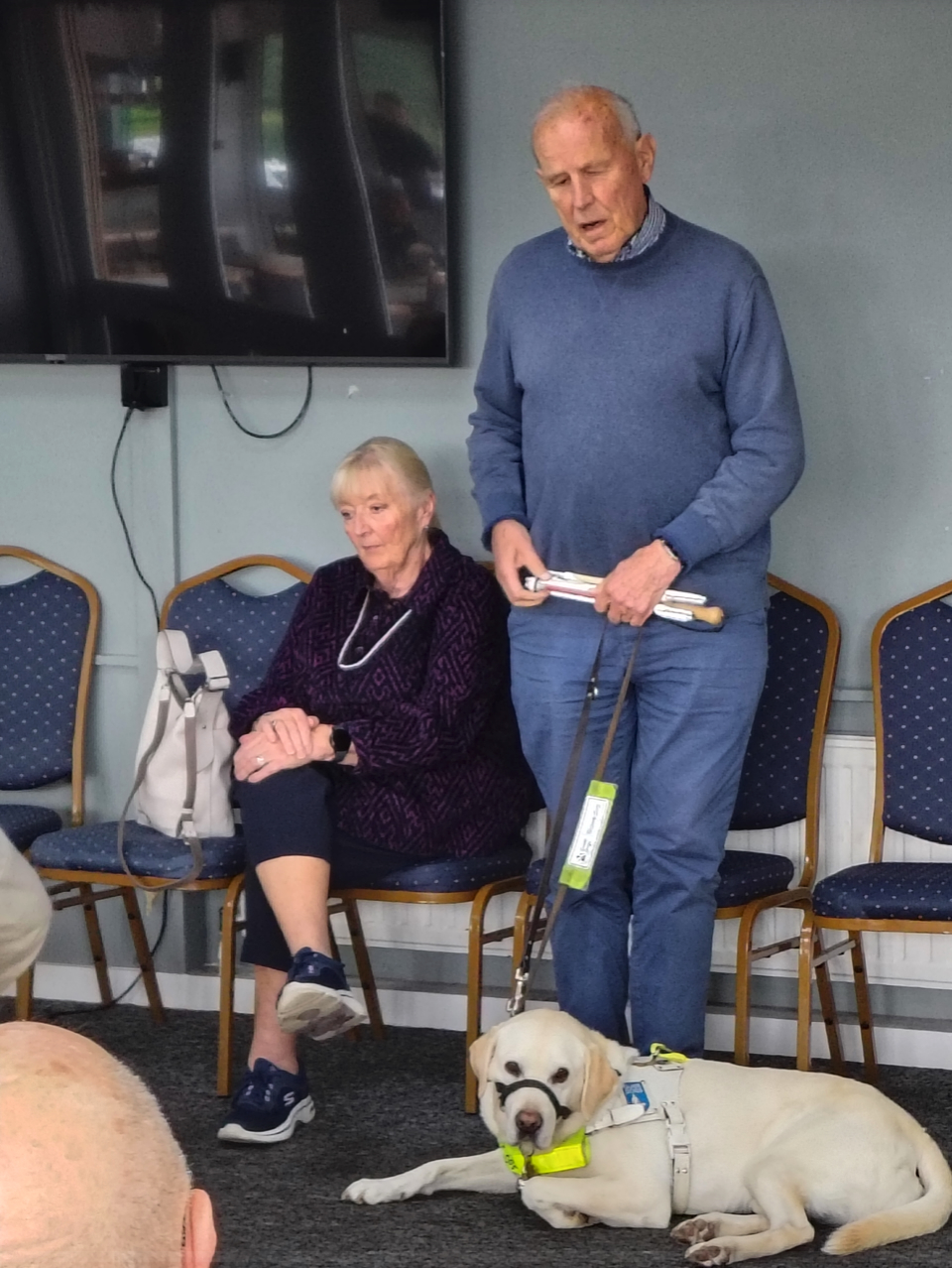
Richard was born in Ireland, one of three boys, all blind from birth. He grew up in Coulsdon, his parents had a grocer’s shop in Rectory Road. His first school, Sunlight House in East Grinstead, was very enlightened where the children could play on or with go-carts, climbing frames and even a donkey, like other boys would have done. Further schools in Wandsworth and Warwickshire were less fun. After school he worked in publishing, successfully running his own business publishing books not for profit, with titles such as “Living with Disabilities”. After work Richard found that retirement did not suit him so he started fundraising for Guide Dogs for the Blind, approaching big organisations like Microsoft, Morgan Stanley and EY.
Guide dogs have been around for nearly 100 years but the TV show “Blue Peter” was very influential in raising the awareness of Guide Dogs and over the years raised large sums to support the training of dogs. The dogs are all raised by volunteers. The puppies are mainly raised in the Midlands and a puppy-raiser looks after them for the first 8 weeks. From then to age 14 months other volunteers complete the initial training such as basic hygiene and house training, and introducing them to the world in which we live, and everyday situations such as walking the streets, going into supermarkets and on buses.
After 14 months the dogs start their intensive training, learning the skills needed to be a guide dog, such as learning to stop at the kerb, or stop at the top or bottom of stairs. By the feel of the harness the owner can tell if the stairs go up or down. Dogs destined for London have to go for additional training to navigate the more complex world of London such as the underground and escalators as well as the extra noise and crowds. After training, the new owner, dog and trainer spend around 10 days together in a hotel to get to know each other and build up a rapport between dog and owner. To show one of the skills learnt Richard gave a demonstration, saying “Find the door”, and Twiggy led him straight to the main door, with only a sideways glance at the other doors. Richard then had to find the door handle and how to get out of the room.
Richard did not have a guide dog until he was 48. His brothers still do not have guide dogs. It has made him much more independent and he feels confident enough to go to London on his own. Guide dogs retire at 10 years old, and Twiggy is due for retirement soon. However, if Twiggy goes Richard will not be able to get another guide dog for twelve months so he hopes to be able to keep Twiggy for a bit longer, past her tenth birthday. Otherwise he will have to go back to using a cane, which is much slower, more stressful and not so safe.
If you see a blind person trying to cross the road, do offer to help. Richard would say “Yes”, although partially sighted people might say “No”, to maintain their independence. Dogs cannot cross roads except at lights as they cannot determine the speed of a car, or whether it will stop.
There was applause at the end of his talk, and Twiggy stood to receive his applause also.
The New Geriatric Carer
by Vincent Fosdike
The scene: Elderly husband and wife watching television.
Husband to wife: “Did you see that flicker on the TV?”
Wife: “What did you say, speak up!!” Husband repeats and asks “What is that smell?
Wife: “It’s NOT ME I told you should have had a bath!!”
Husband: “No, a sort of burning smell, look it’s really flickering”
Wife: “Turn the volume up I can’t hear over your muttering about Pickering”.
Husband presses the remote volume control and the picture fades to black.
Wife: “Now look what you’ve done, and that smell is getting worse oh why don’t you go and have a bath or something, you’re no use at all !!”
Husband rushes to unplug the set and shouts to his wife to open the door.
Wife: “there’s no need to get like that”.
Husband: “The telly is smoking”.
Wife: “It can’t be. Right in the middle of the final episode –couldn’t it have waited till tomorrow?”
Husband seizes the set and makes for the garden at some risk of a slipped disk/hernia or, heart attack. He deposits still smoking much loved old friend on the concrete path, wondering if this would make up for not getting any medals during national service overseas on the Isle of Wight.
Once over the shock he suggests using the computer which they have never done before.
The point is they have no idea how to “tune it in”. About an hour latter they discover a Channel which offers what they are looking for BUT seems to require some form of ID check and an entry code.
Perhaps they will just go to bed and try tomorrow. The next day they allocate the afternoon to logging on without their son’s assistance as he has declared that his mental health isendangered by their inane questions, and he has a young family to care for. The oldies are past help and should stick to books just like the “good old days!!!!!”
After about an hour Mum and Pop have developed joint level of digital expertise approaching critical mass. A code will be sent to them and verified after which access will be granted to digital T.V. It duly arrives and they find out how to apply it along with a password which they must remember or write down and keep at a separate address.
Success, the tiny computer screen opens and offers various forms of with and without payment and options of live or online viewing etc. These need consideration and perhaps carry the risk of credit card fraud. Better just stick to the free all repeats channels. It is just bad luck if we can actually remember the endings. That is the trouble with old age you forget what you had for lunch, but thirty-year-old films are easy to recall, and live news broadcasts are just the same as the Suez crisis and the Hungarian uprising in essence.
Once into the full works Mom and Pop feel at ease with 12-inch screen (it brings them together). BUT, just as all in the garden seems rosy, messages keep coming up to the effect that their computer can no longer handle some channels as its browser is out of date.
All this and our son has only just taken the good old telly to the tip.
Husband wonders if this happens in the old folks’ home as the sets age faster than the residents – must check the fine print in the contract sitting on the sideboard.